
Safety and Satisfaction: Balancing Human Factors & UX
By Gianna MaaddiIn the world of product development, Human Factors (HF) and User Experience (UX) are treated as distinct disciplines. While UX is associated with digital delight, Human Factors is seen through the lens of regulation and risk mitigation.
Despite their differences, these disciplines share a common purpose: human-centered design. By embracing the unique perspectives of both, designs can become more effective by combining “easy to use” with “safe to use.”
As a UX Researcher, I’ve seen firsthand that treating these fields as separate entities is a missed opportunity. The best designed products don’t just “pass” a validation study; they are designed with both HF safety and UX intuitiveness in mind.
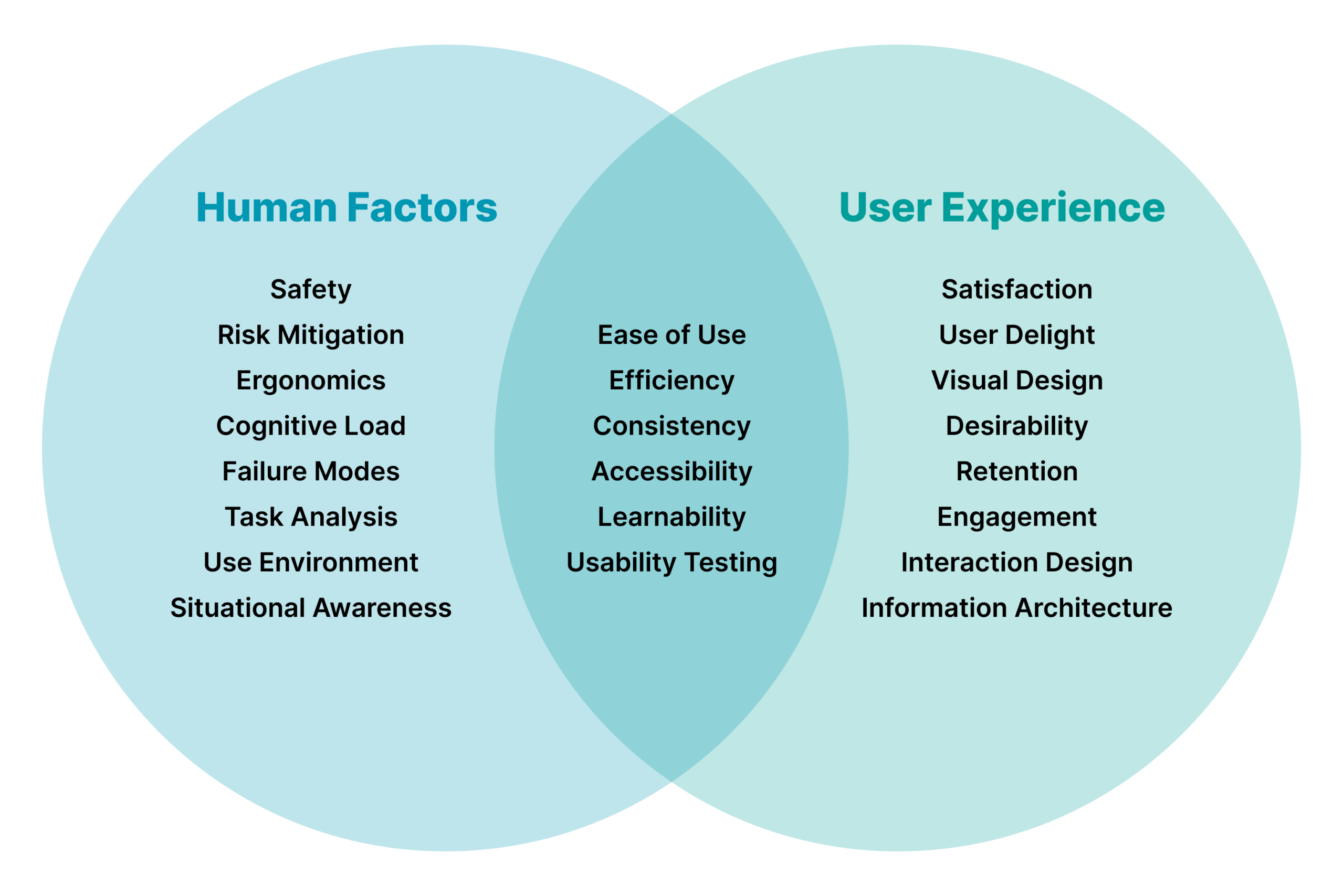
HF and UX focus on safety and satisfaction, respectively, while sharing a common purpose in human-centered design.
Sources: FDA (2016); International Ergonomics Association; Endsley (1995); Nielsen, J. (1994); Interaction Design Foundation
Safety is Necessary, But Not the Only Factor
My transition from a background in UX Design into the rigorous world of Human Factors for medical devices was a fundamental shift in stakes. Human Factors introduced me to a world with a higher level of risk where a lack of intuitiveness can lead to real harm.
Yet I saw that it became more important than ever to adopt the mindset of the end user. Medical device users may have little choice in the products they use, but that doesn’t mean that satisfaction and visual design should be neglected.
I’ve heard users say time and time again that medical devices can feel “intimidating.” Studies have even found that the complexity of advanced medical devices can create significant “emotional barriers” for users [1]. This is a legitimate pain point that can be mitigated by improving user experience through UX research.
In addition to making a product safe and functional, visual design can lead to perceptions of trustworthiness or comfort. Even a small increase in a user’s confidence can impact their interaction with a device. In fact, studies on medical diagnostic equipment found that user-centered design significantly increased the odds of users feeling confident, whereas poor design and high perceived workload had the opposite effect [2].
These seemingly small factors can have a significant impact on the overall user experience.
Preventing Use Errors with UX Design
To further demonstrate the power of a dual Human Factors and UX approach, consider the evaluation of a digital interface, such as an Electronic Health Record (EHR) system, in a high-stress hospital environment.
A Human Factors practitioner might observe a nurse participant selecting the wrong patient in an EHR due to the similarity of two patient names (e.g., Sara Jonas and Sarah Jones). HF practitioners don’t just stop at classifying this as a “use error”; they use Root Cause Analysis to determine if the error was a “slip,” a “mistake,” or a design-related issue.
They might also notice that the selection process takes too long, identifying a delay in care as a failure mode. These use errors could even be exacerbated by cognitive overload or environmental stressors.

Design issues, such as a lack of hierarchy, can lead to use errors and a delay in care
Now, consider how a UX perspective complements this Human Factors analysis. While HF identifies that a design-related risk may exist, a UX lens reveals underlying factors of where the design breaks down and how it can be improved. These gaps may include:
1. Information Architecture: Is the nurse “slipping” because the interface lacks visual hierarchy? A wall of text where patient names carry the same visual weight as IDs and dates of birth (DOB) demands more cognitive focus to scan for differences.
2. Interaction Design: Is there a deliberate forcing function? Without a verification step to confirm the name, DOB, and room number, the system allows users to proceed on “autopilot.” In the absence of this additional step, the nurse may eventually have to backtrack to a previous page to correct their selection, introducing unnecessary clicks, frustration, and further delays.
In this scenario, HF proves that risk exists and identifies the clinical consequences. UX provides the design expertise to identify the specific issues introduced by the interface and determines exactly how these use errors can be mitigated through better design.
Validation ≠ Perfection: The Importance of Mitigations
Early in my career, I grew accustomed to discovery research where data was converted to design recommendations early enough to be easily implemented.
Testing with users early and often ensures that products are designed in a way that aligns with how users actually think and act, while preventing exponential increases in cost should major changes be required after a design is frozen.
However, in the reality of compressed development cycles, a full UX process isn’t always prioritized before reaching the validation stage. Shifting into the world of validation studies provided a necessary reality check.
It can be difficult to witness participants making use errors at such a late stage, knowing that only minimal changes can be made before a product is finalized. By the time a product reaches validation, significant R&D investment has already been committed, regulatory submission timelines have been set, and manufacturing has already been in the works. At this point, substantial redesigns are rarely financially and technically feasible.
Through this, I gained a new appreciation for built-in safeguards. I realized that 100% success is an impossible benchmark; our goal should be resilience. In both HF and UX, this means creating “forgiving” systems through layers of risk mitigations.
In digital design, this might mean disabling a “Submit” button until a required field is filled out, preventing a logic error before it happens. With a medical device, this might mean implementing a system that detects a missed calibration step, notifying the user immediately, preventing the device from being used unsafely.

Safeguards can make systems more “forgiving,” and reduce the likelihood of use errors
Adopting a Hybrid Perspective
In practice, the best solutions aren’t about choosing one discipline over the other; they are about committing to human-centered design with every asset available. UX-minded professionals can help translate clinical requirements into human needs early in the process using tools like user personas and journey maps. By mapping a clinician’s motivations and pain points before costly manufacturing begins, we identify opportunities for improvement that satisfy regulatory needs while incorporating the “intuitive” features that might otherwise be dismissed as “nice-to-haves” if identified too late.
The Bottom Line
We acknowledge that everyday users are often stressed, tired, and distracted. We cannot predict every challenge users may face, but by designing with a hybrid mindset, we build the safeguards that catch them when they stumble.
By combining the empathy of UX with the technical standards of Human Factors, we give users exactly what they need to use a product safely and successfully on their own.
Ultimately, bridging the gap between HF and UX delivers both safety and satisfaction, accomplishing their shared purpose of human-centered design.
References
- Sarac, E. (2025). Relationship between the use of smart medical services and mental health status. World Journal of Psychiatry. https://doi.org/10.5498/wjp.v15.i1.101246
2. Budowski et al. (2022). Improved Task Performance, Low Workload, and User-Centered Design in Medical Diagnostic Equipment Enhance Decision Confidence of Anesthesia Providers. https://doi.org/10.3390/diagnostics12081835